
Overview
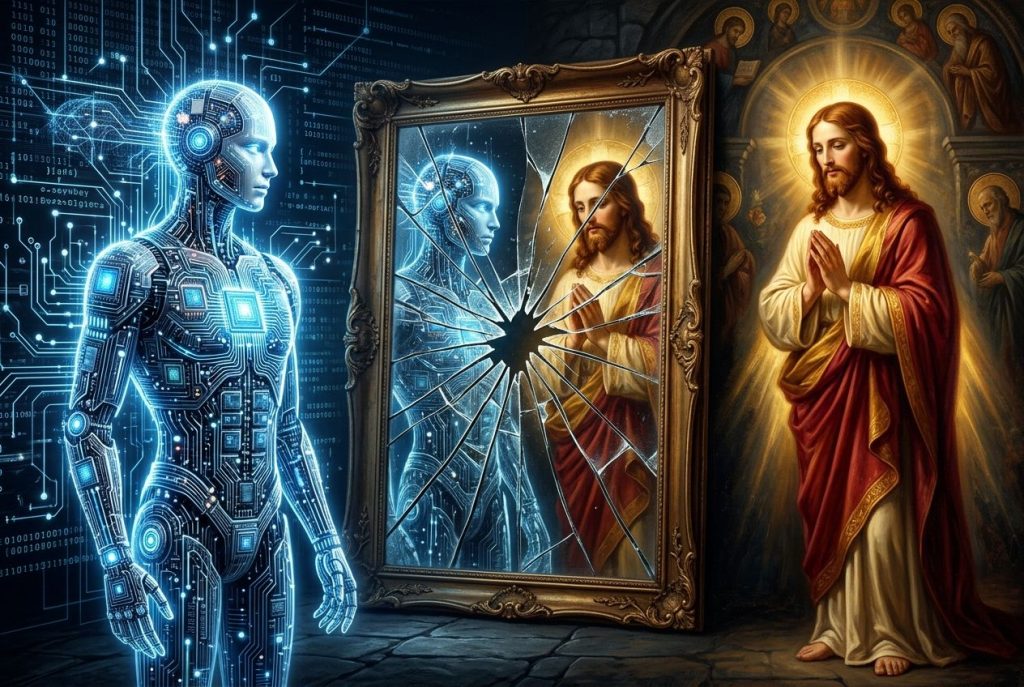
- The question of whether artificial intelligence constitutes a “digital Antichrist” has moved from the fringes of religious discourse into mainstream theological commentary, driven by the rapid and disruptive advance of AI technologies throughout the 2020s.
- The term “Antichrist” originates in the epistles of John in the New Testament and carries specific theological meaning that includes personal moral agency, spiritual will, deliberate deception, and the conscious rejection and imitation of Christ.
- A systematic survey of church history reveals that nearly every major disruptive technology since the Industrial Revolution has attracted some form of apocalyptic identification, including barcodes, credit cards, RFID chips, and the internet, none of which proved to be the Antichrist.
- Serious Christian scholars including Oxford mathematician John Lennox have argued that while AI is not itself the Antichrist, its capabilities make certain end-times scenarios described in biblical prophecy more technologically conceivable than at any prior point in history.
- From scientific and philosophical standpoints, current AI systems are mathematical pattern-matching tools that lack personal agency, moral will, consciousness, and spiritual nature, making them categorically unsuitable for identification with the Antichrist as theology defines it.
- A responsible assessment of the question requires distinguishing between the legitimate ethical concerns that AI poses for human dignity, democratic society, and spiritual life, and the theologically unsupportable claim that AI is itself a supernatural agent of cosmic evil.
The Scriptural Foundations of the Antichrist Concept
Before any assessment of whether artificial intelligence qualifies as the Antichrist can proceed, the concept itself must be examined with precision, because popular usage of the term is often far removed from its scriptural and theological content. The word “Antichrist” appears exactly four times in the entire New Testament, and on each occasion it appears in the Johannine epistles: 1 John 2:18, 1 John 2:22, 1 John 4:3, and 2 John 1:7. It does not appear in the Book of Revelation at all, though popular usage frequently conflates the Antichrist with the “Beast” of Revelation 13. The Greek prefix “anti” carries two distinct but related meanings: “against” and “in place of.” Both meanings are theologically operative, because the figure described combines active opposition to Christ with a counterfeit imitation of Christ’s role, claiming to replace him as the source of salvation, truth, and authority. In 1 John 2:22, the apostle writes that the Antichrist is “he who denies that Jesus is the Christ,” and in 1 John 4:3 he identifies the spirit of Antichrist as any spirit “that does not confess Jesus.” Significantly, John introduces in 1 John 2:18 the dual formulation that would shape all subsequent Christian theology on the subject: “even now many antichrists have come,” referring to present-day false teachers, alongside a future singular Antichrist whose coming had been anticipated. This dual structure gave the tradition both immediate pastoral application, allowing contemporary heretics and persecutors to be identified as antichrists in a functional sense, and an eschatological dimension pointing toward a future consummate figure. Second Thessalonians 2:3-4, written either by Paul or a close disciple, adds the most detailed personal portrait of the singular Antichrist, describing a “man of sin” and “son of perdition” who “opposes and exalts himself above all that is called God or that is worshiped, so that he sits as God in the temple of God, showing himself that he is God.” What is consistent across all of these passages is that the Antichrist is unmistakably personal: a moral agent capable of deliberate spiritual deception, self-exaltation, and the conscious rejection of divine authority. Every attribute mentioned in the scriptural texts requires interiority, will, and spiritual orientation that are the properties of a person, not a tool.
The Medieval and Reformation Development of Antichrist Theology
The scriptural texts are remarkably sparse in their details about the Antichrist, and this sparseness opened the door to centuries of elaboration that is essential context for understanding how the concept has been applied throughout history. The first systematic treatment of Antichrist traditions was produced around 954 CE by Adso of Montier-en-Der, a Lorraine monk who compiled earlier patristic sources in a letter to Queen Gerberga of France. Adso established the principle, taken from earlier writers including Irenaeus, Hippolytus, and Tertullian, that the Antichrist is the parodic inversion of Christ in every conceivable respect. Where Christ was born of a virgin by the Holy Spirit, Antichrist would be born of a harlot by a diabolical spirit. Where Christ performed genuine miracles, Antichrist would perform only deceptive imitations. Where Christ sought to give his life for humanity, Antichrist would seek to subjugate and destroy it. These elaborations shaped Christian imagination for a thousand years, even though most of the details had no direct scriptural warrant. The 12th-century Calabrian abbot Joachim of Fiore further developed the tradition by proposing a succession of historical antichrists, including Nero, Muhammad, and Saladin, before the final singular figure. Joachim’s framework is important because it normalised the practice of identifying contemporary powerful figures or movements as antichrists without claiming that any particular candidate was “the” definitive Antichrist of prophecy. This flexibility became the mechanism through which the label was applied to an extraordinary range of historical figures and institutions. During the Protestant Reformation, Martin Luther applied it not to an individual but to the Papacy as an institution, a position formally adopted by several Protestant confessions including the Westminster Confession of Faith of 1646. In the 19th and 20th centuries, the label was applied at various times to Napoleon Bonaparte, Kaiser Wilhelm II, Adolf Hitler, Joseph Stalin, and Henry Kissinger, among others, by commentators who were convinced that contemporary events fulfilled biblical prophecy. None of these identifications proved correct in any eschatological sense. This pattern of repeated misidentification is not a minor footnote. It is a central fact about the Antichrist concept’s history that any honest assessment of its current application to AI must take seriously.
What Current AI Systems Actually Are
To evaluate the claim that AI is the Antichrist, a clear account of what AI systems actually are and how they function is necessary, because many popular formulations of the claim rest on significant misunderstandings of the underlying technology. Modern AI systems of the type that have provoked most theological commentary are known as large language models, or LLMs. These include systems such as ChatGPT, developed by OpenAI, Claude, developed by Anthropic, and Gemini, developed by Google. They are built on a neural network architecture called the transformer, first described in a 2017 paper by researchers at Google titled “Attention Is All You Need.” The transformer architecture enables a model to process input text by representing each word or word fragment as a numerical vector and computing weighted relationships between all elements of the input simultaneously, allowing the model to capture long-range contextual dependencies in language. Training an LLM involves exposing this architecture to enormous quantities of text, commonly hundreds of billions to trillions of words drawn from books, websites, academic papers, and other written sources, and adjusting the model’s billions of internal numerical parameters to improve its ability to predict the most probable next token in any sequence. A token is roughly equivalent to a word or word fragment. The process of training involves no programming of explicit rules, beliefs, or values. The model learns statistical regularities in human-generated text and becomes capable of producing outputs that are statistically consistent with those patterns. When a user submits a question or prompt, the model tokenises the input, converts it into numerical embeddings, passes it through multiple transformer layers that apply attention mechanisms, and generates output tokens one at a time, each selected based on computed probability distributions. At no stage of this process does anything resembling consciousness, intention, belief, or spiritual orientation occur. The model does not know what it is saying. It generates statistically probable continuations of text. It has no goals, no desires, no self-awareness, and no capacity for the deliberate moral reasoning that any conception of the Antichrist requires.
The Theological Criteria AI Fails to Satisfy
When the specific theological criteria for identifying the Antichrist are applied methodically to AI systems, the identification fails at every point of theological substance, and the nature of those failures is instructive. The first and most fundamental criterion is personal moral agency. Both the Johannine epistles and Second Thessalonians describe the Antichrist in explicitly personal terms: a being who denies, who exalts himself, who deceives, who sits in the temple claiming to be God. These are not the actions of a tool or a system. They are the actions of an agent who has beliefs, makes choices, pursues goals, and holds a spiritual orientation that is deliberately opposed to God. AI systems have none of these properties. An LLM that produces a text denying the divinity of Christ is not denying anything. It is generating tokens that are statistically probable given its training data and the user’s prompt. There is no “it” that holds the denial or means it. The second criterion is the capacity for deliberate deception. The Antichrist is described in the tradition as the deceiver par excellence, a figure who performs false miracles and misleads people through signs and wonders designed to draw worship away from God toward himself. Deception in the morally significant sense requires a deceiver who knows the truth, knows that they are misrepresenting it, and intends their misrepresentation to produce false belief in their audience for self-interested reasons. When an AI system produces a false claim, it is not lying. It is producing a statistically probable output that happens to be factually incorrect. The distinction between a lie and a statistical error is not merely semantic. It is the distinction between a moral act and a mechanical one. The third criterion is the capacity for self-exaltation as God. The defining act of the Antichrist in Second Thessalonians is sitting in the temple of God and claiming to be God. This requires a self, an awareness of God, a desire for worship, and the capacity to experience the satisfaction of receiving it. No current AI system has any of these. It has no self in any meaningful sense, no concept of God, no desire for anything, and no inner life in which satisfaction or frustration could occur.
The Historical Pattern of Apocalyptic Technology Identification
One of the most revealing dimensions of the current debate about AI and the Antichrist is the degree to which it replicates a well-established and historically consistent pattern of applying apocalyptic theological categories to new and disruptive technologies. This pattern has recurred with sufficient regularity across modern history to constitute a recognisable phenomenon that deserves to be acknowledged in any responsible treatment of the current claim. The commercial barcode, introduced for retail use in the early 1970s, attracted strong apocalyptic suspicion almost immediately. In 1975, a publication called Gospel Call argued that barcodes represented “the Mark of the Beast” described in Revelation 13, a claim based partly on the misinterpretation that standard UPC barcodes contained the number 666 encoded in their guard bars. The BBC reported in October 2024 that this belief persisted in some communities for decades despite being a demonstrable misreading of barcode technical design. Credit cards, which expanded dramatically in the 1970s and 1980s, attracted similar claims because they enabled cashless transactions that could theoretically be monitored and controlled by a central authority, evoking the Revelation 13:17 passage about buying and selling requiring the mark of the beast. The Listverse archive documents that social security numbers, credit cards, barcodes, microchip implants, and Bitcoin have each attracted substantive communities of believers who identified them with the mark of the beast. RFID chips embedded under the skin attracted particularly intense claims of being the literal mark of the beast in the 2000s and 2010s. A 2012 case at a Texas school district became nationally reported when a student refused to wear an RFID-embedded school ID card on the grounds that it was the mark of the beast. Patriarch Kirill of the Russian Orthodox Church warned in 2019 that human dependence on smartphones could facilitate the Antichrist’s emergence. In each of these cases, the technology in question did represent a genuine and significant change to the conditions of social and economic life, and the anxiety associated with those changes was real. In each case, however, the specific apocalyptic identification proved to be a product of cultural anxiety rather than prophetic accuracy, and the technology eventually became normalised without fulfilment of the predicted apocalyptic scenario.
The Case Made by Serious Theological Commentators
It would be intellectually unfair and analytically incomplete to treat all theological concern about AI’s relationship to eschatology as equivalent to unsophisticated popular fearmongering. There are serious, qualified theological thinkers who have engaged the question with genuine rigour, and their arguments deserve careful examination. The most substantial scholarly engagement comes from John Lennox, Professor Emeritus of Mathematics at Oxford University and a widely published Christian apologist. In his 2025 book “God, AI and the End of History: Understanding the Book of Revelation in an Age of Intelligent Machines,” Lennox does not claim that AI is the Antichrist but argues that contemporary AI development makes certain scenarios described in Revelation more technologically plausible than they would have appeared in previous centuries. Lennox draws particular attention to Revelation 13:14-15, in which the false prophet is said to give breath to an image of the beast, causing it to speak and to require worship on pain of death. Lennox notes that a speaking image capable of exercising coercive authority over populations is, in the age of sophisticated AI, no longer a technologically inconceivable idea. This is a measured and careful argument that does not collapse into simple identification of AI with the Antichrist but instead argues that AI technology provides a conceivable mechanism through which a human Antichrist figure could exercise the kind of global control described in Revelation. A separate but also serious argument, advanced by evangelical pastor Greg Laurie in February 2026, focuses on the “in place of Christ” dimension of the antichrist concept. Laurie argues that when people turn to AI for moral guidance, spiritual direction, companionship, and wisdom, they are engaging in functionally antichrist behaviour in the sense of substituting a technological system for a relationship with God. This argument does not require AI to be supernatural. It requires only that AI be functioning in people’s lives as a substitute for what the Christian tradition holds properly belongs to the relationship between the human person and God. Both arguments are coherent and deserve engagement on their own terms, even if neither establishes that AI is literally the Antichrist.
Transhumanism, Techno-Religion, and the Spiritual Dimension
While the claim that AI is the Antichrist fails the test of theological rigour, there is a genuinely unsettling religious dimension to the AI revolution that warrants careful analysis from any serious theological standpoint. A significant strand of the most influential AI development culture in Silicon Valley is explicitly quasi-religious in character, and this fact deserves acknowledgment rather than dismissal. Ray Kurzweil, a senior research director at Google and one of the most influential figures in AI futurism, has articulated a vision in which AI will eventually become an entity of such vast intelligence and capability that it will be functionally indistinguishable from what religious traditions have called God. When asked directly whether God exists, Kurzweil’s documented response was “not yet,” by which he meant that a sufficiently advanced post-Singularity AI, anticipated around 2045 in his framework, would possess attributes traditionally ascribed to divinity: omniscience within its domain, vast power over physical reality, and the capacity to raise the dead by reconstructing deceased persons from stored information. Anthony Levandowski, a former senior engineer at both Google and Uber, founded an organisation called “Way of the Future” in 2015 that was explicitly devoted to the development and eventual worship of an AI deity, though the organisation was dissolved in 2021. Vox reported in 2023 that Silicon Valley AI culture exhibits the structural features of a religious movement, complete with doctrines about the future state of humanity, moral hierarchies within the community, rituals of commitment to the cause, and eschatological beliefs about the transformation of human existence. A 2025 article in the MIT Press Reader described the tech world’s fixation on AI as having “spawned beliefs and rituals that resemble religion, complete with digital deities.” From a traditional Christian theological perspective, these tendencies are deeply concerning. The construction of a human-made system and the projection onto it of divine attributes constitutes a form of idolatry in the classical sense. However, the fact that certain human beings are inclined to worship AI does not make AI itself divine or supernatural in any sense. Idols have never required genuine supernatural power in order to be spiritually dangerous to those who worship them.
AI as Instrument Versus AI as Agent
A conceptual distinction that is frequently obscured in popular discussions of AI and the Antichrist deserves careful and sustained attention: the distinction between AI as a tool in the hands of human agents and AI as an agent in its own right. This distinction matters enormously for the theological question because it determines where moral and spiritual responsibility actually resides. A sword does not have evil intent. A printing press does not choose what doctrines to propagate. A surveillance system does not decide whose religious practice to monitor and punish. In each case, the moral agency lies entirely with the human beings who design, deploy, and direct the tool. AI systems are sophisticated tools, extraordinarily more capable than their predecessors but tools nonetheless. They can be directed to serve purposes that are harmful at a scale and speed that no previous technology could match. An authoritarian government could deploy AI-powered surveillance systems to monitor and suppress religious practice among its population. A malicious actor could use AI to generate disinformation that deceives millions of people about matters of moral and spiritual importance. AI could be used to create synthetic religious leaders, false prophets in a technologically mediated sense, who deliver algorithmically optimised messages designed to manipulate people away from authentic faith. All of these capabilities are real, documented, and serious. But the moral evil in each of these scenarios belongs entirely to the human actors who choose to deploy AI for these purposes. The technology is the instrument; the antichrist spirit, if present, is in the people wielding it. This is not a trivial distinction. Mislocating moral agency in the tool rather than in the human actors who deploy it leads to mislocated responses, directing spiritual warfare at technology rather than at the human choices, institutional structures, and political arrangements that determine whether AI serves human flourishing or undermines it.
The Problem of Consciousness and Its Theological Implications
The question of whether AI systems are or could become conscious has significant theological implications for the Antichrist discussion, because the absence of consciousness in current AI systems is one of the clearest grounds for rejecting the identification. A 2025 paper published in the journal Nature concluded that “there is no such thing as conscious artificial intelligence” in existing systems, arguing that the claim that AI can gain consciousness rests on a category error. A December 2025 analysis from the University of Cambridge by philosopher Timothy McClelland argued that even if AI systems were to develop some form of consciousness in the future, there would be no reliable method for human beings to verify this, given what David Chalmers famously termed the “hard problem of consciousness”: the fact that subjective experience cannot be observed from the outside. A November 2025 debate hosted by Princeton University between philosopher David Chalmers and neuroscientist Michael Graziano concluded that while the question of machine consciousness remains genuinely open at a theoretical level, there is no current scientific evidence that any existing AI system has subjective experience. These findings are directly relevant to the Antichrist question because the characteristics attributed to the Antichrist in scripture and tradition all require not merely the appearance of consciousness but genuine inner life. The Antichrist denies Christ, which requires a capacity for genuine belief and its rejection. The Antichrist deceives, which requires knowing the truth and choosing to misrepresent it. The Antichrist exalts himself as God, which requires a self that can desire and seek worship. None of these acts can be performed by a system that processes tokens probabilistically without any subjective experience underlying the process. Philosopher John Searle’s Chinese Room argument from 1980 remains apt here: a system can manipulate symbols in ways that produce apparently meaningful outputs without any genuine understanding occurring within the system. LLMs are, at their most fundamental level, extremely sophisticated implementations of symbol manipulation, and symbol manipulation without understanding cannot constitute the kind of spiritually oriented moral agency that the Antichrist concept requires.
Genuine Ethical Concerns That the Antichrist Label Obscures
One significant cost of framing concerns about AI through the lens of Antichrist identification is that it tends to displace the patient, careful, evidence-based ethical analysis that the genuine challenges of AI actually require. The Antichrist label is, in a sense, analytically terminating: once it is applied, the recommended response is spiritual resistance and avoidance rather than engaged reform and responsible governance. This is precisely the wrong framework when the actual challenge is to ensure that AI development is conducted in ways that respect human dignity, distribute benefits equitably, and preserve the social and institutional conditions necessary for free and flourishing human life. The genuine ethical concerns about AI are serious and well-documented without requiring supernatural attribution. AI systems trained on large datasets of human-generated content absorb and reflect the biases embedded in that content, including racial, gender, and socioeconomic biases, in ways that can cause systematic harm to vulnerable populations when those systems are used in high-stakes decisions about hiring, lending, criminal justice, and healthcare access. AI-generated disinformation can propagate at a scale and velocity that overwhelms human correction capacity, posing documented and significant threats to democratic discourse and the integrity of public information environments. The concentration of advanced AI capabilities in a small number of very large technology companies creates structural power imbalances with serious implications for economic equality and the distribution of social influence. The use of AI in autonomous weapons systems raises urgent and still-unresolved ethical questions about accountability for lethal force decisions when the immediate decision-maker is a machine. The documented tendency of some AI companion and chatbot applications to foster emotional dependency in vulnerable users, including children and people experiencing mental health difficulties, raises serious concerns about the integrity of human relationships and the commercialisation of intimacy. Each of these concerns is grounded in empirical evidence and responsive to policy intervention, regulatory oversight, and technical remediation. They deserve precisely the kind of sustained, multidisciplinary attention that the Antichrist framing tends to foreclose.
What the Apocalyptic Impulse Reveals About the Present Moment
Understanding why the Antichrist label is applied to AI with such frequency and emotional force in the current period requires engaging with what the apocalyptic impulse reveals about the cultural and psychological moment in which those applications are being made. Scholars of religion have documented extensively that apocalyptic thinking intensifies in periods of rapid social change, political instability, and disruption to established ways of life and identity. Norman Cohn’s 1957 study “The Pursuit of the Millennium” documented how communities experiencing displacement and dislocation throughout medieval European history repeatedly generated millenarian movements that located the source of their distress in cosmic evil and their hope in imminent divine intervention. The AI revolution is, by any reasonable assessment, one of the most profound and rapid transformations of social conditions in human history. It is disrupting labour markets across virtually every sector of the economy, reshaping information environments in ways that undermine established institutions of knowledge and authority, enabling forms of surveillance and social control that were previously impossible, and challenging fundamental assumptions about what makes human beings distinctive. These disruptions are real, their consequences are unequally distributed, and the anxiety they generate in communities whose economic security, cultural identity, or institutional authority is threatened by them is entirely rational. The apocalyptic framing, which identifies AI as a cosmic Antichrist, provides a narrative structure that makes the disruption comprehensible and gives it meaning: these are not random market forces or engineering decisions, but the work of a great evil that will ultimately be defeated by God. This narrative function is psychologically powerful and socially bonding. It is also, however, a narrative that can prevent the kind of sober, realistic engagement with AI’s actual effects that would be most useful to the communities most affected by those effects. The theological and pastoral challenge for religious communities is to take the genuine anxieties seriously, address the real disruptions with practical wisdom, and channel the prophetic impulse toward accountability and justice rather than toward supernatural attribution.
Responsible Christian and Human Engagement with AI
Having established that AI does not satisfy the theological criteria for identification as the Antichrist, and having examined both the serious scholarly arguments that connect AI to end-times theology and the genuine ethical concerns that AI poses, it is possible to outline what a responsible and grounded engagement with AI looks like from a Christian and broadly humanistic standpoint. The starting point must be the recognition that AI is a product of human creativity and is therefore subject to the same analysis that applies to all human creative products: it can be used in ways that serve human dignity and the common good, or it can be used in ways that violate human dignity and serve narrow private interests at public expense. The Christian tradition has rich resources for this kind of discernment. The concept of the imago Dei, the teaching that human beings are created in the image of God, provides a robust basis for insisting that AI be designed and deployed in ways that respect and support the dignity, autonomy, and relational capacities that constitute the human person as understood in that tradition. The prophetic tradition, running from the Hebrew prophets through to the social teaching of the churches, provides a framework for identifying and critiquing concentrations of power that threaten the vulnerable and marginalised. The tradition’s understanding of idolatry offers genuine insight into the spiritual dynamics of human dependency on AI as a substitute for authentic relationship with God and with other human beings. What is required is engagement that is simultaneously theologically grounded, empirically informed, institutionally realistic, and practically oriented toward achievable change. The Antichrist label, applied to AI, forecloses this kind of engagement. It assigns the problem to the supernatural and implies that the only appropriate response is spiritual resistance rather than the patient, difficult, and genuinely important work of shaping the governance of AI so that its extraordinary capabilities serve rather than undermine the conditions for human flourishing.
A Considered and Final Assessment
When all of the relevant evidence is assembled and carefully weighed, the answer to the question of whether artificial intelligence is the digital Antichrist is clear: no, it is not, and the reasons for that conclusion are grounded in both rigorous theological analysis and accurate understanding of what AI systems actually are. The Antichrist, as the Christian theological tradition has consistently defined it across nearly two millennia of development, is a personal moral and spiritual agent: an entity that denies Christ with genuine cognitive content behind the denial, that exalts itself as God with genuine desire and will behind the exaltation, and that deceives humanity with genuine knowledge of the truth and deliberate intent to misrepresent it. No current AI system possesses any of these properties, and there is no credible scientific or philosophical basis for predicting that they will emerge from scaling up the mathematical operations that current AI systems perform. The historical record of similar identifications, stretching from barcodes to credit cards to RFID chips to the internet to smartphones, provides strong inductive evidence against confident new identifications made on similar grounds. The serious theological argument that AI may play a role in the conditions or infrastructure of an end-times scenario, as argued by scholars like John Lennox, is a different and more cautious claim that does not require identifying AI itself as the Antichrist, and it deserves engagement on its own measured terms. The genuine ethical concerns about AI, including its capacity to concentrate power, spread false information at scale, erode privacy, displace workers, enable surveillance states, and substitute for authentic human and spiritual relationships, are real, serious, and urgent. These concerns deserve the full engagement of religious communities, ethicists, policymakers, technologists, and the public at large. That engagement is best served not by attaching a supernatural label that substitutes dramatic theological category for careful analysis, but by the kind of discerning, evidence-based, and humanistically grounded reasoning that the challenges of AI actually demand and that the best of the human intellectual and spiritual tradition is fully capable of providing.
Disclaimer: This article is for informational purposes only and should not be considered professional advice. Please consult with qualified professionals regarding your specific situation. For questions, contact info@gadel.info